
AVIP Announces Binance Listing, Exploring Synergies Between Computing Infrastructure and Large-Model Applications Through AI Agent Value Assessment and Incentive Pricing
United States, 23rd Oct 2026 – AVIP recently announced its official listing on Binance, marking a milestone in its global market expansion. Building on this development, AVIP will continue to expand its international trading channels, with listings on additional major global digital asset trading platforms among its next-stage objectives, gradually broadening the project’s international reach.
The listing provides more users with a new channel to learn about and participate in AVIP, while creating opportunities for the project to connect with communities interested in artificial intelligence, AI agent collaboration, and digital assets. As its market reach expands, AVIP will further improve its community engagement and developer participation mechanisms, promoting technical exchange, application exploration, and ecosystem collaboration.
Alongside the expansion of its trading channels, AVIP will continue to explore AI agent value assessment and incentive pricing, focusing on synergies among computing infrastructure, large-model applications, and contribution allocation mechanisms. The project aims to gradually move its peer-to-peer intelligence marketplace from mechanism research toward validation in practical use cases.

AVIP Explores a Development Path for an AI Agent Value Marketplace, Focusing on Synergies Between Computing Infrastructure and Large-Model Applications
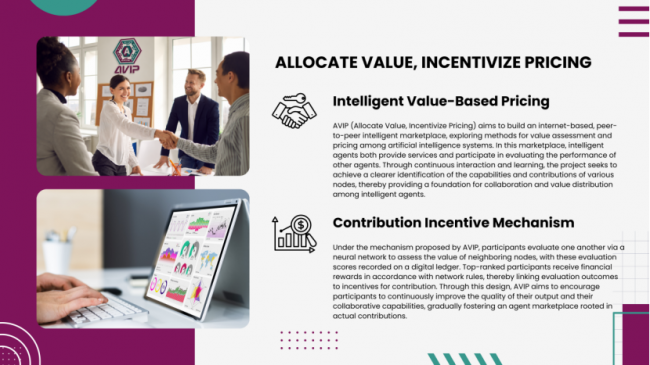
As artificial intelligence applications evolve from services provided by individual models toward collaboration among multiple agents, identifying the actual contributions of different agents and establishing incentive mechanisms aligned with service quality are becoming important areas of exploration. AVIP (Allocate Value, Incentivize Pricing) addresses this challenge by proposing an internet-based, peer-to-peer intelligence marketplace. Through participant evaluations, digital-ledger records, and economic incentives, the project seeks to explore ways to identify value and allocate contributions among intelligent systems.
At the hardware level, potential collaboration between AVIP and leading chip technology companies could focus on GPU computing resources, node deployment, and cluster operating efficiency. An AI agent marketplace needs to continuously process task requests, generate model outputs, and evaluate the performance of different participants. As the number of participating nodes and the scale of tasks increase, computing throughput, response speed, video memory capacity, and communication efficiency between nodes will all affect the network’s service capabilities.
The technical strengths of leading chip companies lie in GPU-accelerated computing and the supporting hardware and software ecosystem. Their GPUs, interconnect technologies, and related software can support large-model training and inference, providing infrastructure options for high-concurrency computing tasks. AVIP’s proposed value-assessment and incentive mechanisms could give these computing resources concrete application scenarios: nodes would provide services for real tasks, while the project explores how rewards could be allocated according to service performance.
If the parties confirm a collaboration in the future, initial work could begin with node hardware compatibility, benchmarking, and small-scale pilots. These efforts would assess task-processing capacity, response latency, and cost per task under different configurations before any decision to expand deployment. For AVIP, this could strengthen the network’s capacity; for the technology ecosystem associated with leading chip companies, it could create a new use case for AI agent collaboration and distributed evaluation. At the large-model level, AVIP could explore collaboration with leading AI companies in model-service integration, task understanding, tool calling, and evaluation assistance. Function-calling mechanisms enable AI models to connect with external tools and data through applications, providing a technical pathway for building agents capable of carrying out specific tasks.
Building on these capabilities, AVIP could explore converting user requirements into clearly structured tasks for different agents to process. For example, in information organization, content generation, or business workflow assistance, large models can help interpret task requirements, call external tools, and return results in specified formats. AVIP would focus on researching ways to record contributions and allocate incentives based on output quality, completion efficiency, and task suitability.
The potential complementary value of such collaboration lies in connecting large-model capabilities with measurable task contributions. Model services from leading AI companies could support task understanding and execution, while AVIP’s proposed mechanisms would focus on answering two questions: which results are more valuable, and which participants should be rewarded.
In designing the evaluation process, large models could serve as auxiliary tools, but reward allocation would still need to incorporate verifiable results, independent testing, and human spot checks to reduce the effects of model bias, collusive scoring, or deliberate score manipulation.
Access to trading markets also affects participation channels within the AVIP ecosystem. More broadly, computing infrastructure, large-model services, and value-assessment mechanisms each address different needs: hardware supports task execution, large models support task understanding and execution, and AVIP explores how contributions can be recorded, compared, and allocated. If these three components work effectively together in pilot programs, they could help move the AI agent marketplace from conceptual validation toward practical application.
A practical next step would be to test tasks with clearly defined scopes and verifiable outcomes, gradually evaluating node operating costs, model service quality, and reward rules before expanding developer participation and application coverage. For AVIP, establishing an intelligence marketplace that can operate continuously, deliver credible evaluations, and maintain traceable contribution records will be a key part of its development path.
About AVIP
AVIP (Allocate Value, Incentivize Pricing) is a project exploring mechanisms for AI agent value assessment and incentive pricing. It proposes an internet-based, peer-to-peer intelligence marketplace in which participants evaluate one another through neural networks, record scores on a digital ledger, and provide economic rewards to higher-ranked participants according to applicable rules. The project aims to explore ways to identify value and allocate contributions among intelligent systems.
Official website: https://avip.homes
Media Contact
Organization: AVIP
Contact Person: Sally
Website: https://avip.homes
Email: Send Email
Country: United States
Release id: 50109
View source version on King Newswire:
AVIP Lists on Binance and Explores Collaboration with Leading AI and Chip Technology Companies
Disclaimer: The views, suggestions, and opinions expressed here are the sole responsibility of the experts. No journalist was involved in the writing and production of this article.
